



Hi! Thanks for being curious about my newest attempt at a blog. If you're a regular user, an occasional skimmer or just a first-time diver into my first blog, "Pretty Wonderful Communication" - thanks for stepping in to look over some related ideas. Why write something new? Longtime "PWC" readers may have noticed that my professional interests have broadened to include public health questions, sometimes peripheral to the everyday concerns of a clinical speech - language pathologist. Here's my attempt to make discussions on populations with communication disorders more easily available, while I give greater attention to the needs of individual consumers in the other blog.

Talking about population or public health will immediately raise the hackles of those who say - persons who work in public health can't be trusted. Not only do disgruntled citizens point to the many missteps government officials made during the COVID - 19 pandemic, but they also point to the tendency of some government officials to protect us from - everything! Seat belts are mandated; lead water mains removed; mosquito screens on windows; Tylenol and other products gain safety seals; baby formula plants repaired; avian flu bringing euthanizing of chickens and eggs; coke ash kept out of public waterways; and RSV-prone seniors inoculated within nursing homes. All these public health interventions - are they the mark of a stern, oppressive nanny state?
Richard and Robert Sherman, in their song "The Perfect Nanny" written for Disney's "Mary Poppins", would argue that - it depends on how the caregiver communicates with objects of care. Jane and Michael swore in their song, that
"If you won't scold and dominate us We will never give you cause to hate us We won't hide your spectacles So you can't see Put toads in your bed Or pepper in your tea"

Public health concerns: I've thought repeatedly that Communication Sciences and Disorders (CSD) professionals should swing for the fences, when we talk about affecting population health. We should look to change how cardiovascular disease burdens the people we serve, so our populations can grow healthier. Regardless of your work setting, your consumers' age ranges, or your level of experience in clinical work, cardiovascular health remains the #1 risk for morbidity and mortality around the world.
If CSD professionals could include activities in their tool kits that either directly eliminate or lessen risks for impairment of body function after cardiovascular disease, there might be lower numbers of persons suffering the disease's effects - stroke, kidney disease, cochlear hearing loss, all manifestations of heart disease, many of the dementias, and others. By the same token, the CSD professional who is conducting regular surveillance of a target population - to identify individuals who are already at risk of significant disability - can then move quickly to limit functional disability for all those surveilled.
The blog title: I first heard this song treated instrumentally by guitarist Ry Cooder, on side 2 of the first digital rock album "Bop Til You Drop". https://youtu.be/_oYzxkfzJZ0?si=9zWIk5OOJuY0tOWs . The song was initially recorded with vocals by Ike and Tina Turner https://youtu.be/Rj9Um8T88KM?si=c7fuJLbb9uDDf4fs , and still another vocal version was done by Linda Ronstadt and James Taylor https://youtu.be/1Eqxc8l1XjQ?si=-vTlZgKrmk9m39eR . Through all the versions, you're hearing that better days lie ahead. We in the CSD world may see better days ahead for our careers, when we can help our consumers lessen their risk for disability. Now, to review the path for lowered cardiovascular risk:

A related focus for this blog is that cardiovascular risk reduction must be a lifetime pursuit for all ages, starting before children begin school and continuing through the life span. A targeted age range for risk reduction of cardiovascular disease is 20 - 39 years, a portion of the life span Balanced against the simple need to maintain optimum health, are the pressures of a person's culture. For example, if you've grown up with fried foods and those are the foods most accessible, tastiest and within your budget, they may be the foods you most easily eat. I've formulated some questions to examine the behaviors of college - aged students in the Chicagoland area. Many of these schools have training programs in CSD. To get a baseline feel for what access these students have to healthy food, I decided upon these -
Initial questions:
1. Where can you get a satisfying burger at a decent price?
2. Where can you get culturally indigenous foods eaten by communities in the metro area?
(Example: Falafel pita sandwich)
3. Where can you find vegetarian/vegan food near you?
(Example: plant-based burger)
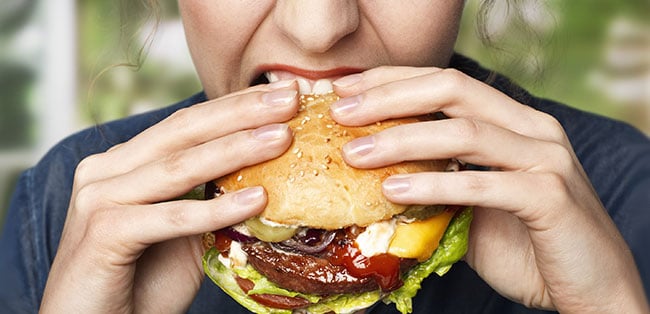
A rubric for answering the first question came out of a survey published in January 2023 by the website BrokeScholar, in coordination with Yelp. Students enrolled in 144 institutions of higher education were examined for their fast food preferences, when given the option to get eats within two miles of campus. I gleaned from the report, among many of the relevant mileposts measured, that surveyed students gave BLAZE PIZZA its highest national score, but the students claimed sandwiches as their overall favorite fast food. Student rankings for favorites in the Midwest were: BLAZE PIZZA, McDONALD's, followed by JIMMY JOHN'S, POTBELLY and PITA PIT. In addition, CULVER's is the highest - scoring Midwest restaurant. Regardless of what business the chain restaurants are generating around college campuses, it is the local fast food restaurants that score Yelp points with the students.
Now let's drill down to examine fast food preferences of just one of the regional schools; one that offers an undergraduate minor, Bachelor of Arts and Master of Science degrees in CSD. St. Xavier University is located in the Mt. Greenwood neighborhood of Chicago, on the southwest side of the city and almost 20 miles from the Loop district. In the Fall of 2022, St. Xavier reported that 49.4% of all students identified as LatinX, 32.2% of the students identified as white, and 11.80% as African - American. Burger restaurants near the St. Xavier campus, and their most recent Yelp ratings, follow.
|
||||||||||||||||||||||||||||||||||||||||||||||||||||||||||||||||||||||||||||||||||||||
| * local restaurant | ||||||||||||||||||||||||||||||||||||||||||||||||||||||||||||||||||||||||||||||||||||||
 |
||||||||||||||||||||||||||||||||||||||||||||||||||||||||||||||||||||||||||||||||||||||
| Preliminary analysis of data obtained for one Chicagoland university suggests that the trend of strongly supporting local fast food restaurants (e.g., burger restaurants) by their students holds true. Further posts will examine how the relationships between college students and their diet preferences might affect their cardiovascular health. It's in your best interest to keep reading. Honest! |
||||||||||||||||||||||||||||||||||||||||||||||||||||||||||||||||||||||||||||||||||||||
